
Mt. Fagan as seen from Sycamore Canyon 1-21-2010
It was a busy weekend here and Sunday we just crashed and watched TV, but by Sunday evening I was itching to get out of the house and see some birds. I know that the nighthawks have been spotted in the area, but I had yet to see any for myself. Knowing that we used to see them all the time in Sycamore Canyon of Corona de Tucson, Gus and I decided to go for a drive and see if we could find some.
The sun is still shining and the air still warm and dry as we hop into the convertible. Gus heads for Old Spanish Trail and we wind our way along the Rincon Mountains and up through Vail in order to avoid the Pima County Fair Traffic on Houghton Rd. Here in Arizona they do their county fair in spring instead of autumn. I am guessing this is due to the weather, which is perfect at this time of year!
 As we drive through Vail Town Center the road starts to climb toward the Santa Rita Mountains. Above us the sky is mostly clear. I am lost somewhere deep in thought as the miles slip by. Soon we are turning onto Harrison Road with the Mt. Fagan and the Santa Rita Mountains looming ahead. Gus cannot resist a drive past our old house and I see that the cactus garden we planted out front is still there and one cactus is blooming bright pink blossoms!
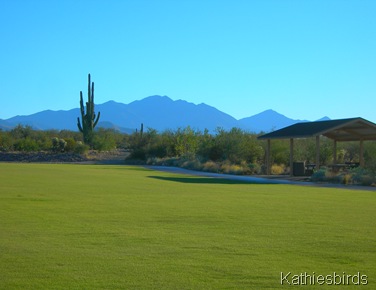 We head down to the park then and park our car and get out. While the park looks pretty much the same, there are a lot more people and dogs in it. Someone has a whole team of huskies! They look so out of place here in the desert. I grab my bins and notebook and we take of walking. Gus soon goes ahead of me while I linger to look for birds, but all I am seeing are Mourning Doves and White-winged doves, and a lone Cactus Wren. In the desert I hear Curve-billed thrashers and Gambel’s Quail.
I see a desert cottontail hiding just off the path wanting to get out onto the lush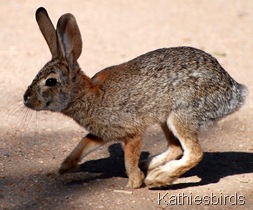 green lawn of the park, but still leery of all the people and dogs. Behind it a jack rabbit looks like a giant as it dwarfs the smaller rabbit with its huge feet, legs, and ears. While I am enjoying seeing these creatures, it is still not what I came to see! I scan the park, the desert, and the sky for nighthawks, but see none. I finish my circuit around the track and make it back near the parking lot. By now Gus has done several laps and the sun has set. People have left the park and we are just about the only ones left. As I wait for Gus to come around again I scan the desert for nighthawks and find a Great Horned Owl perched atop a tall saguaro instead. Its silhouette looks like an eared lump against the tangerine sunset!
  The temperature has dropped quite a bit by now but we still leave the top down as we get back into the convertible. We drive away from the park and Sycamore Canyon without seeing a single nighthawk. I find this distressing since I know they used to be here on a regular basis. I ask Gus to drive by Road Runner Market at the junction of Houghton and Sahuarita Roads as it has numerous street lights and often there are nighthawks hunting for insects here. We drive east on Sahuarita Road, then turn south on Houghton where Gus does a u-turn and we are now facing north. All this time I have been scanning the sky overhead for nighthawks to no avail. I have not seen one. As we wait at the stop light in the left turn lane to drive down to Sahuarita I suddenly see motion across the street from us on the northeast corner of the intersection. This is not a nighthawk. It is a large raptor, an owl, but too pale for a Great Horned Owl. I train my binoculars on the bird, which has landed on a fence post low to the ground, and discover it is a Barn Owl! With no one behind us we sit through three changes of the light while I watch this magnificent raptor as it turns its head from side to side searching the ground below for prey. We finally make the turn and drive away without knowing if the owl got to eat tonight. As Gus turns the car west I am smiling like a Cheshire Cat moon in the night.
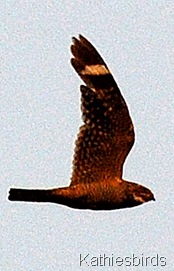 All along the ten or more miles to Sahuarita I am looking for nighthawks in street lights to no avail. We spend about 30 minutes or more in the grocery store before getting back into our car to head home. I ask Gus to drive through Rancho Sahuarita as we head north. The paved road snakes through the development with street lights scattered here and there. It is as we are nearing the end of the road that I see a well lit parking lot off on my right. As Gus drive forward suddenly I see the ghostly flash of a bat-like body as it moves in and out of one of the street lights! Nighthawks! “Gus!” I yell, “I think I just saw some nighthawks!” My patient husband turns the car around and we drive back to the parking lot. Sure enough, as we park beneath one of the lights we see the nighthawks swooping and fluttering like giant moths hawking for insects.
 We sit there in the darkness, bathed in the glow of street lights and watch the birds swoop, dive and flutter. Their erratic flight is so unpredictable. Their bodies so cryptically colored, yet I can see their notched tails streaming out behind them, and the white or buffy patches in their wings. We get mostly Lesser Nighthawks here in Arizona, but it is possible to find common nighthawks as well. In the Lesser species the females have a buffy patch on their wings, instead of the white patch of the male Lessers or both sexes of Common Nighthawks.
 I think I could have stayed there and watched those birds all night long, but after ten to fifteen minutes we finally left. It is hard for me to drive away in this cool night air, because I am still concerned for this species of bird. I did not see very many insects in the street lights. When there was a brief bit of insect activity suddenly eight nighthawks came into the lights at once, then they were gone, and so were the insects. Until that one moment Gus and I had only see four nighthawks at the same time. The nighthawks seem to prefer the lights that were nearest the open desert beyond. I did not see them hunting at any of the lights nearer the center of the parking lot.
So, it was with a somewhat sad smile that I left the birds behind me as Gus drove away. Here in Sahuarita the temperature had dropped to 65F! But, by the time we got back up to Tucson it was back to 75F! That just shows you the effect of the “heat bubble” created by the city. I am happy to have finally seen my nighthawks, but a bit concerned about their population. I know so many insects are being poisoned by pesticides and along with them, the wildlife that feed on them. We must find a way to live with these creatures that share the earth with us. All of our lives are enriched by their presence.
Happy Earth Day!
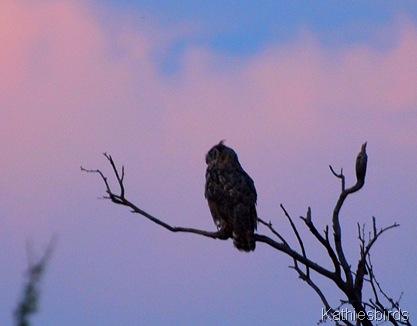 Great Horned Owl in Sycamore Canyon 8-8-2008
Note: All photos in this post are from my archives from when I lived in Sycamore Canyon between 2007 and 2010. While I no longer live in Sycamore Canyon, I do have friends who do. I did not have my camera with me on this drive. Besides, it was soon too dark for photography! This post was originally posted on my Kathie’s Birds blog for Earth Day.


